The Science of Self-Sustaining Power
A patented internal energy regeneration paradigm that eliminates dependency on external power sources — forever.
How Internal Energy Regeneration Works
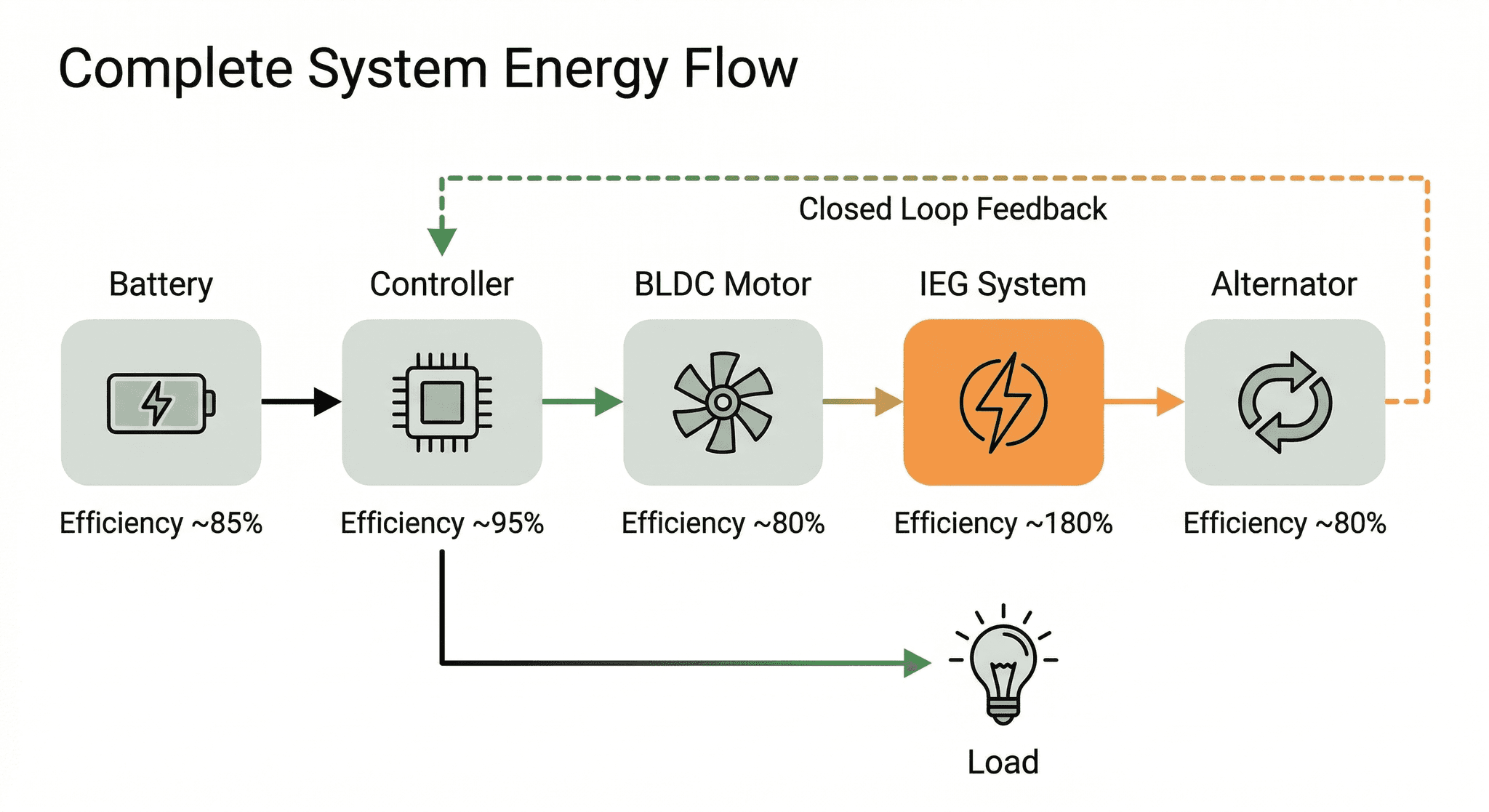
In the concept working of IEG technology, the battery is connected to an electronic controller which regulates power delivery to the BLDC motor. The battery operates at approximately 85% efficiency, while the controller transfers power to the motor with about 95% efficiency. The BLDC motor itself functions at around 80% efficiency and converts electrical energy into mechanical rotational energy.
This rotational output is mechanically coupled to the IEG system where mechanical, electrical, and magnetic energy are combined to enhance energy utilization, resulting in an operational efficiency of approximately 180%.
This processed energy is then transferred to an alternator operating at about 80% efficiency, taking around 80% of the energy from the IEG system to generate electrical power. This is supplied back to the controller, forming a closed loop. The controller sends the received alternator power back to the motor to maintain operation, and any remaining energy is provided as usable output.
The Concept & Blueprint
Our patented internal loop isn't just theory—it is a functional blueprint that bypasses the constraints of conventional power loss. Below is the simplified flow of how the IEG unit powers the future.
To understand this with an example:
Consider a battery rated at 12V, 10A supplying 2A current to the motor. In this case, the motor receives an electrical input power of 24 watts. This 24-watt output is processed through the IEG system, where due to its 180% operational effectiveness, the power is represented as approximately 44 watts equivalent.
About 80% of this 44-watt power is transferred to the alternator, allowing the alternator to operate with around 34 watts. The alternator converts this energy back into electrical form and sends it to the controller. After accounting for the controller's own efficiency of 95%, approximately 38 watts of usable power are available.
From this, the controller supplies about 24 watts back to the motor so that the cycle continues running, around 1 watt is directed to the battery, and the remaining 10 watts are available as output power, which can be used to charge the battery, power external loads, or be utilized elsewhere as required.
Energy Amplification
Through advanced Magnetic Boost (MB) integration, the system intercepts back-EMF and multiplies the base magnetic flux. This allows the generator to output up to 180% of the power it takes to drive the motor, fundamentally outperforming standard alternators.
Closed-Loop Regeneration
A calibrated smart battery charger routes a calculated portion of the excess energy back to the primary 12V-60V batteries. Because the generation rate outpaces both the load draw and battery depletion, the system becomes a continuous, self-sustaining loop.
Total Grid Independence
Producing perfectly stable 240V/50Hz AC power with an integrated inverter stage, the IEG operates entirely off-grid. With zero fossil fuels required, it drastically cuts operating costs and completely removes carbon emissions from the power-generation cycle.
Government-Granted Patents
Internal Energy Generating System
A System for Regeneration of Internal Energy
Petrol vs Electric vs IEG
| Feature | Petrol Scooty | Electric Scooty | IEG Scooty |
|---|---|---|---|
| Power Source | Fossil Fuel | Electric Battery | ∞ Internal Energy |
| Charging Infra | Petrol Pumps | Electric Outlets | No Charging Needed |
| Environmental Impact | 23,000 gm CO₂/liter | Grid-dependent | near Zero Emissions |
| Carbon Credit | None | Partial | Full Eligibility |
| Range | Limited by fuel | Limited by battery | ∞ Unlimited |
| Charging Time | 5 min fill | 4-6 hours | No Charging |
| Running Cost | High (fuel prices) | ₹5,040/year | ₹0/year |
| Grid Independence | Petroleum supply | Grid availability | Total Independence |
EV vs IEG: Running Cost
2-Wheeler
4-Wheeler
E-Rickshaw
IEG Power Station Specs
Detailed specifications will be Updated Soon.